Showing posts with label holidays. Show all posts

Monday, April 9, 2012

Yom HaBikkurim, urban legend

The title of this blog post is meant to catch your attention.  "Yom HaBikkurim, urban legend"!  Can it be true?

Well, not exactly.  Let me explain.

In Messianic Jewish circles, I regularly encounter references to the first day of the omer count as "Yom HaBikkurim."  I grew up with this being taught to me and continue to encounter it both on blogs and in books.  (Not to mention the omer count debate.  Seriously...don't mention it.  Not going there on this post.)  [Update: The reason for this teaching is to justify using the name Yom HaBikkurim as a "kosher substitute" for the term "Easter," the latter being something a non-sequitur of a name for those who didn't grow up within a tradition that uses it.  The underlying assumption is that Yom HaBikkurim is the Biblical holiday on which the resurrection of Yeshua took place.  For examples, simply Google "Yom HaBikkurim."]

However (unless one of you can persuade me otherwise), I'm strongly leaning towards the conclusion that "Yom HaBikkurim" refers not to the first day of the omer count at all--but rather, to the day AFTER the LAST day of the omer count.  In other words, Yom HaBikkurim is not a complete urban legend...it's another name for Shavuot.

Let's start by considering Numbers 28:26:
On the day of the firstfruits, when you offer a grain offering of new grain to the Lord at your Feast of Weeks, you shall have a holy convocation. You shall not do any ordinary work.
This verse equates "the day of firstfruits" (yom habikkurim) with "your Feast of Weeks."  A.k.a. Shavuot.

Case closed, right?

No--there's more!  Let's check out Leviticus 23--the chapter that holds all the answers, right?
And the Lord spoke to Moses, saying, "Speak to the people of Israel and say to them, When you come into the land that I give you and reap its harvest, you shall bring the sheaf of the firstfruits of your harvest to the priest, and he shall wave the sheaf before the Lord, so that you may be accepted. On the day after the Sabbath the priest shall wave it." (Lev 23:9-10)
Let's see: waving firstfruits, day after the Sabbath ...maybe (ignoring Num 28:26 for a second) this is Yom HaBikkurim?

I see two problems with this reading.  The first problem is that "firstfruits" are also mentioned later on in the chapter:
...count fifty days to the day after the seventh Sabbath. Then you shall present a grain offering of new grain to the Lord. You shall bring from your dwelling places two loaves of bread to be waved, made of two tenths of an ephah. They shall be of fine flour, and they shall be baked with leaven, as firstfruits to the Lord. (vv. 16-17)
and again in verse 20:

And the priest shall wave them with the bread of the firstfruits as a wave offering before the Lord, with the two lambs. They shall be holy to the Lord for the priest.
The second problem is that the word בִּכּוּרִים, bikkurim, does not appear in Lev: 23:9-10.  (Say what?)  That's right, the reference to "a sheaf of the firstfruits" in 23:10 is actually a translation of the phrase (עֹמֶר רֵאשִׁית, omer reisheet).  When the word bikkurim does appear in verses 17 and 20, it is referring to Shavuot.

I am aware of the section of mishna Zeraim called Bikkurim, but in my (limited) searching so far, I've seen no reference to the first day of the omer count as Yom HaBikkurim.  Strong's concordance 1061 also seems to concur with me here: "day of the first-fruits (Pentecost) Numbers 28:26."

In support of the first day of omer count as Yom HaBikkurim idea, I have only two observations (neither of which I find convincing):

First, many Bibles have a header above Leviticus 23:9-14 such as "The Feast of Firstfruits."  While that certainly predisposes readers of those Bibles to see that passage as describing such a festival (even leading some Biblical conspiracy theorists to speculate about why the feast of firstfruits "disappeared" from the Rabbinic calendar), it hardly constitutes an authoritative interpretation of the passage itself.

Second, there is the statement by the apostle Paul in 1 Cor. 15:20:
But in fact Messiah has been raised from the dead, the firstfruits of those who have fallen asleep. 
Paul is certainly using the language of harvest to describe Messiah's resurrection.  But I'm not convinced we can infer that the first day is "Yom HaBikkurim" in any official sense solely on this basis...only perhaps in a symbolic sense.

We might also ask whether Leviticus 23:9-14 is meant to be read as a distinct section from 15-22, but [see below] rather than going on, I think I'll simply close by restating my thesis as a question:

Is there any basis for referring to the first day of the omer count as Yom HaBikkurim?  Show me what I'm missing, friends!

Oh yeah, and happy Omer/Bikkurim to you all.

Update: I'm sure I'm not the first one to point this out.  So, wrong or right, if you want to point me towards articles addressing what I bring up here, I'd appreciate that too!

Second update: I had briefly suggested that perhaps Lev. 23:9-14 and 23:15-22 were not two distinct units, but verse 15 brought me back to reality: "From the day after the Sabbath, the day you brought the sheaf of the wave offering, count off seven full weeks."

Sunday, April 1, 2012

Reclining at the seder table

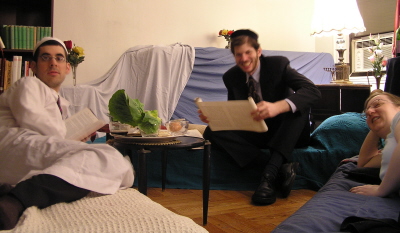
Have you ever wondered about the whole "tonight we recline" line in the haggadah?  These two self-described "text geeks" did...so they decided to hold their seder last year in ancient fashion.
...formal meals during the classical rabbinic period were conducted in the format of the classical world. Diners reclined on couches to take the Meal of Freedom, in the manner of the aristocracy of the time.


Nowadays we sit up to table for the Meal like usual, but we “recline” by leaning on our elbows on the table just like our mothers always told us not to. Sometimes with cushions, which knock over glasses and bang into one’s neighbour.

Ever since I was told this, I’ve wanted to conduct a seder reclining, with couches, but that is hard when you are always a guest at someone else’s seder.

This year, however, planning seder with Mar Gavriel, I said “I’ve always wanted to make seder on couches,” and he, being similarly geeky and eccentric, bounced and said “Me too!”

So we did. We dismantled the dining table and made couches from mattresses. We draped many drapes, found tiny tables, arranged cushions upon which to recline, and presented a seder in Ancient Greek style.


Check out the full article at Jewschool.

Wednesday, November 23, 2011

A Jewish Thanksgiving?

With so much hardship across the world, and even here in the USA we have so much to be thankful for. Here are just a few (from the 2001 AJC Thanksgiving Haggadah):

We are thankful for the freedom from hunger.
We are thankful for the freedom to worship.
We are thankful for the freedom to challenge our minds.
We are thankful for the freedom to change our minds.
We are thankful for the freedom to chart our lives.
We are thankful for the freedom to work for a better world.
We are thankful for the freedom to celebrate this day.
Did you catch that? Go back and read it again. Yep: A Thanksgiving Haggadah.
"Wait...isn't the haggadah for Pesach?"
Yes...traditionally...however:
“Thanksgiving is truly an American holiday. Whether your family came to this country 200 years ago, 20 years ago, or 2 years ago, it’s a celebration that’s easy to embrace. Sharing a meal and a feeling of gratitude transcends racial, ethnic and social boundaries. We may all eat different foods, we may speak a multitude of dialects and languages, but on this day, we share in the best that is America…For American Jews, it is another opportunity to share in a meal similar to the Passover Seder. And similar to that Seder, in which we tell the story of our people’s journey out of slavery in Egypt, on this night we tell the story of our own journeys to this country. Because of its lack of religious particularity, this is an excellent opportunity to share the feast with both Jewish and non-Jewish family and friends.”  - Rabbi Phyllis A. Sommer (author of the 3 different Thanksgiving sederim provided in the first link below)
Jews have a very distinct way of living, of praying and even of celebrating. Here are few different resources to help make your American Thanksgiving a bit more Jewish:
The official Reform blog offers 3 different Thanksgiving sederim (based off of the Passover Haggadah).
Click here to download this year’s American Jewish Committee’s Thanksgiving reader (interfaith, interracial and inter-ethnic in design).
And lastly, here is a short Thanksgiving seder using siddur Sim Shalom.

May your time with loved ones be full of blessings and wonderful memories.

“Happy Thanksgiving” from us here at Gathering Sparks!!

Tuesday, October 18, 2011

Gilad comes home


.ברוך אתה ה' אלוקינו מלך העולם מתיר אסורים

Blessed are you, Adonai our God,
Sovereign of universe,
who releases the captive.
 

Also worth reading: this moving article by Messianic Jewish blogger Abba Lazarus:
"Our children understand that ten thousand terrorists cannot take away our love for them."

Sunday, October 16, 2011

Building a sukkah

Friday, July 1, 2011

What is freedom?

“We hold these truths to be self-evident, that all men are created equal, that they are endowed by their Creator with certain unalienable Rights, that among these are Life, Liberty and the pursuit of Happiness. — That to secure these rights, Governments are instituted among Men, deriving their just powers from the consent of the governed, — That whenever any Form of Government becomes destructive of these ends, it is the Right of the People to alter or to abolish it, and to institute new Government, laying its foundation on such principles and organizing its powers in such form, as to them shall seem most likely to effect their Safety and Happiness.”i


“…for the only person who is truly free (“ben horin”) is one who occupies himself with Torah study…”ii

i. Thomas Jefferson (primarily), “The Unanimous Declaration of the Thirteen United States
of America” (Philadelphia, 1776). Available at: http://www.ushistory.org.


ii. Avot 6:2, translated by Chief Rabbi Lord Jonathan Sacks in The Koren Siddur (Jerusalem: Koren Publishers, 2009), pp. 676-677.


 As we head into this weekend of U.S. Independence Day, I thought it would be worthwhile to share this essay by Cheshy Kopel from YU's Kol Hamevaser on similarities and differences between the American concept of liberty and the Jewish value of herut:


In Search of Liberty: An Important Interaction of Hazal's Values and Mankind's Unalienable Rights

Have a good weekend!

Tuesday, December 21, 2010

Toronto Post article on Messianic Jews and Christmas

The Toronto Post has a lengthy article on Messianic Jews featuring Emmanuel Messianic Jewish Congregation (founded in 1915!  website: http://godwithus.org/).  Here's an excerpt from author Alen Abel's conversation with Rabbi Barry Rubin:

In the rabbi’s study above the part-time prayer hall, we enjoy a lively conversation about the Nazarene and his disciples.
“Virgin birth?” he says. “That’s very Jewish. The first three matriarchs – Sarah, Rebecca and Rachel – were barren. God performed a miracle and ‘opened their wombs.’ One would expect the pattern to continue with the birth of a messiah, too.
“Christmas is a thoroughly Jewish holiday in essence. But like a lot of Christians, it has lost its Jewish roots. I honour the birth of the Messiah – that’s important. Isaiah predicted it. It’s foreshadowed in Genesis. It’s theologically essential, but Christmas isn’t.
“Look, I’m an American. The American Christmas is fun, it’s beautiful. The decorations are pretty but they’re not Jewish, plus they’re not Scriptural.”
Rabbi Rubin says that his research leads him to conclude that the Son of God was born at harvest time, not the winter solstice.
“Why won’t you say the name ‘Jesus’? “ I ask.
“We’re trying to overcome two thousand years of anti-Jewish actions by Jesus’s followers,” he replies. “We’re trying to make a point. When he was a child, his mother would have called him Yeshua. She wouldn’t have yelled ‘Jesus! Time to come in for dinner!’ “
Read the rest at http://life.nationalpost.com/2010/12/20/alen-abel-the-jews-who-believe-in-jesus/.

Sunday, January 31, 2010

A Belated Post for Tu B'shvat

From A Fire Burns in Breslov:
Rav Yisroel Salanter zt”l had a student who was famous for his diligence as well as his creative thinking; he had the distinction of being both a masmid and a mechadeish. This bochur studied many years under Rav Yisroel, but one day, to the shock and dismay of all the other students, the “prodigy” went off the derech!

When the terrible news was brought to the Rav, he displayed no surprise at all.

“During all the years that I oversaw this student’s progress, I never glimpsed the least glimmer of joy on his face. He worked very hard to grasp the depth of a subject, but it was obvious that he was never really moved by any of his chiddushim. He never allowed himself to be connected to the Torah, and so it was easy for him to fall away!”
Let this story be an exhortation to take stock of the "fruit" produced in our lives last year and to connect yourself to the true Vine this coming year!
I am the vine; you are the branches. If a man remains in me and I in him, he will bear much fruit. Bear much fruit, and so show yourselves to be my disciples. ~R. Yeshua

Tuesday, January 12, 2010

Rosh Chodesh

This week's haftorah is from Isaiah 66 due to Rosh Chodesh--the new moon. Here's an excerpt from torah.org:
[...] a greater dimension of Rosh Chodesh was intended to be and will eventually become a reality. The Tur in Orach Chaim (417) quotes the Pirkei D'R'Eliezer which reveals that Rosh Chodesh was actually intended to be a full scale Yom Tov [i.e. holiday]. The Tur quotes his brother R' Yehuda who explains that the three Yomim Tovim correspond to our three patriarchs and that the twelve days of Rosh Chodesh were intended to correspond to the twelve tribes. This link reveals that each Rosh Chodesh truly has a unique aspect to itself and that one of the Biblical tribes' remarkable qualities is available to us each month. However, as the Tur explains, due to an unfortunate error of the Jewish people this opportunity has been, to a large degree, withheld from us.

But in the era of Mashiach this error will be rectified and the experience of Rosh Chodesh will actually reach its intended capacity. Yeshaya reflects upon this and says at the close of our haftorah, "And it will be that from month to month. . . . all will come and prostrate themselves before Hashem." (66: 23) The Psikta Rabbsi (1:3) explains that in the days of Mashiach we will have the privilege of uniting with Hashem every Rosh Chodesh. All Jewish people will come to the Bais Hamikdash each month and experience His Divine Presence. During the illustrious era of Mashiach sin will no longer exist and Rosh Chodesh will be viewed exclusively as an opportunity for elevation. Each month will provide us its respective quality and opportunity which we will celebrate through the Rosh Chodesh festivities. The sacrifice of Rosh Chodesh will reflect our great joy over being with Hashem and will no longer contain any aspect of remorse or sin. In those days, the experience of His Di vine Presence in the Bais Hamikdash will be perpetuated throughout the month and the entire period will become one uplifting experience.*
*Copyright (c) 2010 by Rabbi Dovid Siegel and Torah.org. The author is Rosh Kollel of Kollel Toras Chaim of Kiryat Sefer, Israel.