
"Follow the Lord your God" (Deuteronomy 13:5). What does this mean? Is it possible for a mortal to follow God's Presence? The verse means to teach us that we should follow the attributes of the Holy One, praised be He. As He clothes the naked, you should clothe the naked. The Bible teaches that the Holy One visited the sick; you should visit the sick. The Holy One comforted those who mourned; you should comfort those who mourn. The Holy One buried the dead; you should bury the dead.
Rabbi Simlai taught: The Torah begins with deeds of lovingkindness and ends with deeds of lovingkindness. It begins with deeds of lovingkindness, as it is written, "And the Lord God made for Adam and for his wife garments of skins and clothed them" (Genesis 3:21). It ends with deeds of lovingkindness, as it is written, "And He buried him in the valley in the land of Moab" (Deuteronomy 34:6).
~Talmud, Sotah 14a
Siddur Sim Shalom, p. 19
Showing posts with label siddur. Show all posts
Showing posts with label siddur. Show all posts
Monday, November 30, 2009
Being "Godly" 2
Continuing our thread on being "Godly":

Thursday, November 19, 2009
Being "Godly" 1
During my Days of Awe postings, I wrote about the 13 midot and what it means to be truly "Godly." There are several great passages from the rabbis on this in the daily prayers of the Siddur, and I want to share them with you.*
To me this teaching is both inspiring and very challenging. Not only that, but I believe that for Messianic Jews, this teaching should be particularly emphasized as a fundamental feature of our community. In the coming weeks, I hope to continue posting on this topic and to present some reasons for why I think it's important.
What say you?
* Don't worry, I haven't forgotten about my follow-up post on the second soul of Shabbat--I decided to save it for tomorrow as it will be a good post leading into Shabbat for this week.
** At least, so far as I could find. If I'm wrong, help me out here!
"To walk in all His ways" (Deuteronomy 11:22). These are the ways of the Holy One: "gracious and compassionate, patient, abounding in kindness and faithfulness, assuring love for a thousand generations, forgiving iniquity, transgression, and sin, and granting pardon. . . ." (Exodus 34:6). This means that just as God is gracious and compassionate, you too must be gracious and compassionate. "The Lord is faithful in all His ways and loving in all His deeds" (Psalm 145:17). As the Holy One is faithful, you too must be faithful. As the Holy One is loving, you too must be loving.In a previous post we discussed the positive mitzvot. Interestingly, this verse in Deuteronomy is not correlated to any of the 248 positive commandments.** And yet the sages see in this verse an injunction to imitate God in His qualities.
Sifre Deuteronomy, Ekev
Siddur Sim Shalom, p. 19
To me this teaching is both inspiring and very challenging. Not only that, but I believe that for Messianic Jews, this teaching should be particularly emphasized as a fundamental feature of our community. In the coming weeks, I hope to continue posting on this topic and to present some reasons for why I think it's important.
What say you?
* Don't worry, I haven't forgotten about my follow-up post on the second soul of Shabbat--I decided to save it for tomorrow as it will be a good post leading into Shabbat for this week.
** At least, so far as I could find. If I'm wrong, help me out here!
Thursday, September 3, 2009
Learning to Dance, Learning to Pray
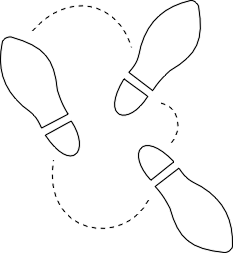 Have you ever wanted to take dance lessons?
I'm not talking about the electric slide. I mean the kind of dancing when you're at a wedding and an old standard comes on, and somebody's aunt and uncle go over to the dance floor, and they start doing a foxtrot. Or swing dancing. Both partners are moving together, they know the right moves to make, and it just looks...beautiful.
I've always liked dancing, but when a song requires a specific step, more often than not I choose to sit and watch. Not because I don't want to join in, but because I don't know the steps.
So how is praying like dancing?
When it comes to prayer, many of us are the same way. We're great at freeform or spontaneous prayer, but when it comes to liturgical prayer, we'd just as soon sit it out. Perhaps you've even wondered: why would anyone want to pray a prayer that's already been written down?
The answer is: for the same reason that couples learn the steps in order to be able to waltz, tango, or foxtrot. The same reason that playwrights write down lines and actors learn them. The same reason that jazz musicians learn standards.
Improvisation, freedom, and spontaneity...
...all three are key ingredients in all three of these activities (dancing, acting, and music). But without the form (steps, scripts, standards), all the spontaneity in the world can still end up feeling rote and tired.
 Jewish prayer is rich with liturgy. To really understand it, you must try to think of the siddur (the Jewish prayerbook) as the steps to a dance. It's merely the outline, to show you where to place your feet. But you're the one dancing...you and God.
And there's more: by supplying you with words to pray, the siddur doesn't just give voice to things you want to say to God. It also teaches you new (old) ways to talk to God--not only individually, but as part of a people who have had an ongoing relationship with the God who first called them into peoplehood.
Prayer and the High Holy Days
The high holy day services have their own special prayers. All of these prayers have important meanings, and without understanding the meanings behind the prayers, we may find ourselves feeling unmoved...or bored. However, if we take the time to learn the meanings behind the traditions, we may discover a wealth of meaning...which will help our own relationship with God.
To learn more about Jewish prayer as "dancing through history," and how the siddur facilitates our "participation in a sacred drama," I recommend reading Rabbi Joshua Brumbach's two part series on rethinking Jewish prayer at the Yinon blog.
As you read Rabbi Joshua's articles, you can think about these questions:
- What is prayer?
- What are some of the obstacles that hinder us from praying? In what ways can the siddur help us to surmount these obstacles?
- In what ways can liturgical prayers enable us to pray together with one voice as a community?
- How does praying the traditional prayers of the Jewish people allow us to connect with Jewish history?
Subscribe to:
Posts (Atom)

