Showing posts with label high holy days. Show all posts

Monday, July 29, 2013

Messianic Jews in New York Times, Christianity Today

Messianic Jews were mentioned in several major media outlets in the past week.

New York Times

From the New York Times article One App, More Than 400 Languages, on the runaway success of YouVersion's Bible app:
Today, the app contains everything from the New International Version to “The Message,” an ultramodern interpretation that reads like a juicy novel. It also includes the so-called Orthodox Jewish Bible, which was actually developed for a religious sect known as Messianic Jews, who believe that Jesus is the Messiah that the Jews await.
Photo credit: New York Times.
From the caption for the above image: "the Orthodox Jewish Bible...created by the Artists for Israel International Messianic Bible Society...incorporates Yiddish and Hasidic cultural expressions into an English translation of both the Old and New Testaments."

The Orthodox Jewish Bible is certainly among the Messianic movement's more idiosyncratic translations (which is saying a lot). This fit right into the article's emphasis on the wide range of different Bible translations available through YouVersion. That said, the two other major Messianic Jewish translations, the Complete Jewish Bible and the Tree of Life version, are also available through YouVersion.

Christianity Today


Christianity Today's recent issue on Leviticus mentions Messianic Jews in two of its cover stories. In Learning to Love Leviticus, Christopher J. H. Wright explains how Christians can treat biblical "as a paradigm or model for our personal and social ethics in all kinds of areas: economic, familial, political, judicial, sexual, and so on"...without "upholding all the jots and tittles." In a paragraph on the food laws, he writes:
The distinction between clean and unclean animals and foods was symbolic of the distinction between Israel as God's holy people and the Gentile nations (Lev. 20:25–26). In the New Testament, that separation is abolished in Christ, as Paul says in Ephesians 2. Through the Cross, God has made the two cultures one new humanity. And as Peter discovered through his vision in Acts 10, before going to the home of the Gentile Cornelius, what God has called clean should no longer be called unclean. Today some Messianic Jewish believers choose freely to observe the kashrut regulations as a mark of their Jewish community and cultural identity. But in their unity, believers are free from food laws.
Kudos to Wright for not ignoring the existence of Messianic Jews in the body of Messiah who observe the kashrut regulations of Leviticus. That being said, I found his claim confusing. Are the kashrut restrictions truly disruptive to unity? (In most Messianic Jewish synagogues I've visited, Jews and Gentiles experience free fellowship over kosher meals.) Furthermore, in conflicts over food between "stronger" and "weaker" brethren, didn't Paul instruct the strong to compromise for the sake of the weak? (This particular line of argumentation assumes that Messianic Jews observing kashrut would be identified with the weak. I myself don't necessarily read the passage that way, but perhaps Wright or those who agree with him do.)

The argument against the food laws from unity strikes me as rather weak on its own. In fact, I suspect that other theological convictions (such as the abrogation of the law in Christ or the supposed dangers of law observance) are really behind this argument, lending it support in the minds of those who accept it. Perhaps as post-supersessionist interpretation of the New Testament gains traction among contemporary scholars, Wright will find this reading of Acts 10 (and other related passages) challenged.

~

Readers who found Wright's comments on Messianic Jews rather uninformed may find much more to appreciate in Philip Cary's Gentiles in the Hands of a Genocidal God. Cary's thesis is that reawakening an awareness of the theological and historical significance of Gentile identity can significantly transform Christian perspectives on the Old Testament's troubling genocide passages. Christians tend to identify too much with Israel, Cary contends, to the point where they forget their place in the narrative. "We have been reading Israel's Scriptures so long that we forget that these words were not originally addressed to us.":
In fact, with respect to the command to exterminate the Canaanites, our position is less like Israel's and more like that of Rahab, the Canaanite prostitute in Jericho who befriends the Israelite spies. She has not taken part in Israel's exodus, but she has heard of it and believes it. She knows the name of the Lord, the God who has given the land to Israel, and she confesses that he is God of heaven and earth (Josh. 2:9–11). She is a believer, and eventually will be included in Hebrews 11's great litany of heroes who lived by faith. But she is not an Israelite. She is a Canaanite who hopes to live, not die. 
As a believer, Rahab can have hope, because the threat she faces is not so much moral as religious. It is not as if the Israelites were so much more righteous than every other nation (Deut. 9:4–6). Israel is holy not because of their own righteousness but because the Lord loves them and chose them as his people. And the holiness of the Lord is a kind of jealousy that claims Israel as his own, not allowing other nations to lead them into worshiping false gods (7:5–8). That is the holiness that leads to herem, the extermination of Rahab's people for their idolatry. 
My proposal is that to read this story properly, as Gentiles, is to put ourselves in Rahab's place. Our origin lies not with the people who hear the command to kill, but with those who are to be killed. We belong with those who should be devoted to destruction because we offend against the holiness of God. And yet what has actually happened is that, like Rahab, we have received mercy through faith in the God of Israel. 
To read the Canaanite genocide this way is to have our hearts formed the way the New Testament intends for Gentiles. 
I'm sure I wasn't the only one shocked to find this in Christianity Today. (For anyone troubled by the "fire and brimstone" tone of the above passage, make sure to read the whole article; Cary also discusses the beautiful consequences of identifying with Rahab, i.e. "You could say that what frees Rahab from herem is hesed, the lovingkindness of her relationship with Israel.")

Before concluding the article, Cary discusses to the historical relationship between Gentile Christians and Israel:
"In you all the families of the earth shall be blessed" (Gen. 12:3, esv)...Christ himself fulfills these words, making the blessing of Abraham into a blessing for all who believe. 
Because of this gospel blessing, we can hear "I am the Lord your God" as words addressed to us, since we too share the faith of Abraham. But notice what this commits us to. It means we Gentile believers in Christ are to be a blessing to the people of Israel, "that by the mercy shown to you they also may now receive mercy," as Paul says (Rom. 11:31, esv). 
Alas, what sort of blessing have Gentile Christians been to Israel? So much persecution of the Jews fills our history. Even our evangelism has often meant attempting to put an end to them. As Messianic Jews have recently pointed out, that is what Christians did by demanding that Jews who accept Christ must cease to practice Judaism—in effect ceasing to be Jews. It meant turning them away from their covenant with the God of Abraham and Moses, as if we had forgotten that this was none other than the God and Father of our Lord Jesus Christ.
Here Cary demonstrates familiarity with the central claims in Messianic Jewish thought--the unity of Jewish identity and Jewish practice, the validity of "Judaism," the deep flaws in the historic Christiant "gospel" of "Jesus, not Judaism." (Readers who find merit in Cary's insights here may want to check out his Jonah commentary before Yom Kippur.)

~

One other article in CT which may be of interest to Messianic readers is Daniel Harrell's account of The 30-day Leviticus Challenge his church did. I was half-expecting a conclusion like this: "After a whole month of these tedious and difficult laws, we were all more grateful for God's grace which sets us free from the law." Sure enough, Harrell set up a conclusion remarkably similar to this...and then elegantly debunked it:
But if reading Leviticus only succeeds in making you feel bad for being a lousy Christian, you've missed its point. Leviticus isn't in the Bible merely to show you your need for grace. It's in the Bible to show you what grace is for. The ancient Israelites were already chosen people before God gave them the Law. The Law's purpose was never to save anybody. Rather, its purpose was to show saved people how to live a saved life.
Reading on, I was also impressed by the transformations Harrell described in the lives of the Challenge participants: continued Sabbath practice, the conclusion that confession of sin is the "modern, post-Jesus equivalent" of sacrifices, and a congregational "Day of Atonement" (during Lent), of which he wrote:
Many left with similar feelings of walking on air—as well as intentions to be more grounded in God—which is precisely what grace (and the Law) are supposed to do. I couldn't help but wonder why we tend to view obedience as so burdensome. Could it be that we've never really obeyed?
Sounds like a pretty decent Day of Atonement to me.

HT Glenn for the tip about the Cary article.


Tuesday, October 4, 2011

Days of Awe...

...is the name of a beautiful piece by R. R. Reno at First Things' On the Square.

Reno writes (on Kol Nidrei):
...this odd petition, presented in the legal context of formally constituted court, comes by way of heart-rending chants. There is not the slightest legalism in the music, which is among the most cherished in the Jewish tradition. Instead, it rings with desperate pleas. The chants sigh and sob. Jews do not kneel to pray; they stand. But in haunting melody of the Kol Nidre, I’ve found my Christian soul driven to its knees.

Therein, perhaps, lies the resolution to the paradox. It is as if the cantor and congregation were saying, “O Lord, I am a precipitous, presumptuous, impetuous fool. Please see that my eager spiritual efforts in the year to come are as likely to be motivated by vanity as obedience, self-interest as devotion.” As far as this Gentile can tell, the spiritual meaning of the Kol Nidre petition accords with the petition I make before I approach the altar to receive communion: “Lord, I am not worthy to receive you, but only say the word and I shall be healed.”
And the conclusion:
I am Christian and not Jewish. I have no real grasp of Hebrew and I only vaguely follow the prayers in my wife’s synagogue. Yet, in the final moments of Yom Kippur I have felt a terrible anguish, yearning to move, and yet immobile, wanting to rush to God’s side and yet nailed to my worldly life. I have shuddered as cantor cries out: “The doors are closing; the doors are closing.” For in those haunting words I hear Jesus saying: “Repent, for the Kingdom of God is at hand.”

Read the full post here.

Tuesday, September 27, 2011

On making things right with God and our fellow human beings

So if you are offering your gift at the Temple altar and you remember there that your brother has something against you, leave your gift where it is by the altar, and go, make peace with your brother. Then come back and offer your gift. If someone sues you, come to terms with him quickly, while you and he are on the way to court; or he may hand you over to the judge, and the judge to the officer of the court, and you may be thrown in jail! Yes indeed! I tell you, you will certainly not get out until you have paid the last penny. 
Matthew 5:23-26 
The sin towards God, the Day of Atonement atones for; but sins toward man, the Day of Atonement cannot atone for till the neighbor has been appeased.
Mishnah Yoma 8
Then Kefa came up and said to him, "Rabbi, how often can my brother sin against me and I have to forgive him? As many as seven times?"
"No, not seven times," answered Yeshua, "but seventy times seven! Because of this, the Kingdom of Heaven may be compared with a king who decided to settle accounts with his deputies. Right away they brought forward a man who owed him many millions; and since he couldn't pay, his master ordered that he, his wife, his children and all his possessions be sold to pay the debt. But the servant fell down before him.
`Be patient with me,' he begged, `and I will pay back everything.' So out of pity for him, the master let him go and forgave the debt.
"But as that servant was leaving, he came upon one of his fellow servants who owed him some tiny sum. He grabbed him and began to choke him, crying, `Pay back what you owe me!' His fellow servant fell before him and begged, `Be patient with me, and I will pay you back.'  But he refused; instead, he had him thrown in jail until he should repay the debt. When the other servants saw what had happened, they were extremely distressed; and they went and told their master every thing that had taken place.  Then the master summoned his servant and said, `You wicked servant! I forgave you all that debt just because you begged me to do it. Shouldn't you have had pity on your fellow servant, just as I had pity on you?' And in anger his master turned him over to the jailers for punishment until he paid back everything he owed.  This is how my heavenly Father will treat you, unless you each forgive your brother from your hearts." 
Matthew 18:21-35


Shanah tovah, dear readers.

Tuesday, August 30, 2011

Free High Holiday Music Sampler from Craig Taubman


Jewish musician Craig Taubman has made Jewels, A High Holiday Music Sampler, available for free on Amazon.com as part of his JewelsOfElul program.  Check it out!

UPDATE: in order to get the songs for free, you need to buy them each individually.  (If you buy the entire album with one-click, it will cost you $7.99.)

Thursday, September 16, 2010

Guest post: On the Yamim Noraim

The following is the first guest post for the days of awe by my best friend Jonathan Roush.  I hope to feature guest posts from him more often in the future...if we're lucky!

Right now the Jewish world is observing Yamim Noraim, "The Days of Awe". This is a time of personal introspection about our behaviour in the last year. We are supposed to recount and remember our sins towards God, to each other and to the world around us.
I've been actively trying to do this and it weighs heavily on my heart. Not in a negative way. I think that feeling the weight of our shortcomings is important to our growth as people.  It's not fun though.

How may times have I spoken negatively about people I know? People I don't know? How many have I judged in my heart?  How many laughs have I had at others expense instead of reaching out a hand of kindness to them? I can't even begin to count...
The ultimate goal of this "remembrance of sin" is that we reconcile ourselves with God, each other and the world around us. We ask forgiveness and take steps towards altering our behaviour. I don't know if this works...but I do know that it sure is nice to deal with some of these things proactively and then to be able to look forward with a clean slate as it were. It's like putting down a heavy bag.

Tuesday, September 7, 2010

Repent, for the kingdom is at hand!

אֶקְרָא וּבְשִׁמְךָ בְּאֱמֶת, אֶתְעוֺרֵר לְהַחֲזִיק בָּך

I will call upon thy name in truth; I will rouse myself to take hold of thee.
Selichot
Just then a woman who had been subject to bleeding for twelve years came up behind him and touched the edge of his cloak. She said to herself, "If I only touch his cloak, I will be healed."
Yeshua turned and saw her. "Take heart, daughter," he said, "your faith has healed you." And the woman was healed from that moment.
Matthew 9:20-22

In this high holy day season, may we all merit to see ourselves as this woman, humbly reaching out to take hold of the Lord. Ketiva v'chatima tovah--may you be written and inscribed for good in the book of life.
Shanah tovah!

Thursday, September 24, 2009

What are you waiting for?

Yeshua taught:
If you are offering your gift at the altar and there remember that your brother has something against you, leave your gift there before the altar and go. First be reconciled to your brother, and then come and offer your gift. (Matt. 5:23-24)
Jewish tradition says that at Yom Kippur, God only forgives sins we've commited against Him. The sins we've committed against other people, we have to go and ask forgiveness for. Yeshua taught the same thing, and he was pretty serious about it:
Come to terms quickly with your accuser while you are going with him to court, lest your accuser hand you over to the judge, and the judge to the guard, and you be put in prison. Truly, I say to you, you will never get out until you have paid the last penny. (Matt. 5:25-26)
It takes a lot of courage to go to someone and apologize, or even to ask, "Is there anything I've done over the year which I should apologize for?" But it sends a message to your loved ones that their friendship is important to you, and it sends a message to God that you truly love Him by loving your neighbor.

So what are you waiting for?

May all of the readers at Gathering Sparks have an easy and meaningful fast.

Return

The Shabbat between Rosh Hashanah and Yom Kippur is called Shabbat Shuvah--the Sabbath of Return. There are two special haftorah readings* for this week which have to do with repentance. Some excerpts:

Hosea 14:1-2

Return, O Israel, to the LORD your God.
Your sins have been your downfall!

Take words with you and return to the LORD.
Say to him: "Forgive all our sins and receive us graciously,
that we may offer the fruit of our lips.


Micah 7:18-19

Who is a God like you, who pardons sin
and forgives the transgression of the remnant of his inheritance?
You do not stay angry forever but delight to show mercy.

You will again have compassion on us;
you will tread our sins underfoot
and hurl all our iniquities into the depths of the sea.


On Shabbat Shuvah, Micah reminds us of something crucial during this season of repentance: Where is God in all of this? Delighting to show mercy.

Yeshua told a famous parable about return: the story of the prodigal son. The point of the parable is that God's response to us when we make teshuvah...is to welcome us back to Him.

To read more about Yeshua's parable, I invite you to check out my first contribution to The Set Table--a commentary on Yeshua's parable of the prodigal son.

May you find shalom as you make your way back to God on this Shabbat Shuvah.

*Hosea 14:2-10, Micah 7:18-20

Tuesday, September 22, 2009

Tashlich

So...by now we've probably devoted a significant amount of time putting into practice all the things we've been talking about: examining ourselves before God, going to other people to apologize for things we've done wrong over the year, repenting for sin, and making resolutions for a better new year...

If that describes you, Baruch Hashem!* If not--well, you're in good company.

Let's face it: our lives are busy. Once we get done at work, there's tons to do at home. And if you're student, well...

Our tradition has a solution for this. It's called tashlich. Haven't heard of it? It's simple: take some bread** (and a few friends if you want) and go to a stream or river. As you throw the pieces of bread into the water, think over the past year--about the things that have come between you and God, or you and other people. Then remember God's promise:
As far as the east is from the west, so far hath he removed our transgressions from us. (Ps. 103:12)
"That's it?" you ask leadingly. "That's it," I reply. There's no special blessings, no particularly prescribed way to do it.

In a season filled with many beautiful prayers aimed to assist us in voicing our heartfelt repentance to God, tashlich stands out as an action so basic that the simplest child can do it, even without fully understanding its meaning.

So if you're feeling like you haven't had enough time this season, I want to encourage you: try doing tashlich before Erev Yom Kippur on Sunday night.

*Bless God.
** You can also do tashlich with pebbles or stones if you feel that using bread is wasteful.

A Simple New Years Resolution

One of my favorite blogs is A Simple Jew. Here's a great example of why:
אתה. I have resolved that this one word, comprised of just three letters, is going to be the focus of my avodas Hashem for 5770. I have rushed over the word אתה so many times... Beginning with the new year, I have made it a practice to slow down anytime I encounter this word... It is my sincere hope that by doing this that my kavana [intent] and deveykus [devotion] will increase significantly over the course of the next year; allowing me to come even just a small step closer to shleimus hatefilla (perfected prayer).
What simple resolutions can you make during these days to help you come closer to God?

(A word of advice: if you make a resolution to do something better this year, tell a friend! I've done this several times over the past few years, and it's made all the difference. Special thanks to those friends--you know who you are!)

Friday, September 18, 2009

L'shana tova!

As we enter into Rosh Hashanah tonight and begin the coming year, may we be strengthened in the message of Yeshua (thanks to Derek Leman for these verses):

The time is fulfilled, and the kingdom of God is at hand; repent, and believe in the good news. (Mark 1:1)

And also in his universal message of repentance and forgiveness.

Forgive us our debts, as we also have forgiven our debtors.(Matthew 6:12)

L'shana tova!

Tuesday, September 15, 2009

God be merciful to me, a sinner!

The week before Rosh Hashanah, it is custom to say special selichot, or penitential prayers, as part of preparing our hearts for the holidays. At certain points during these prayers, it is customary to strike one's chest with one's fist as a symbol of remorse.

This reminds me of the parable told by Yeshua about the Pharisee and the tax collector (Luke 18:9-14):


[Yeshua] also told this parable to some who trusted in themselves that they were righteous, and treated others with contempt: "Two men went up into the temple to pray, one a Pharisee and the other a tax collector. The Pharisee, standing by himself, prayed thus: 'God, I thank you that I am not like other men, extortioners, unjust, adulterers, or even like this tax collector. I fast twice a week; I give tithes of all that I get.' But the tax collector, standing far off, would not even lift up his eyes to heaven, but beat his breast, saying, 'God, be merciful to me, a sinner!' I tell you, this man went down to his house justified, rather than the other. For everyone who exalts himself will be humbled, but the one who humbles himself will be exalted."

Tuesday, September 8, 2009

Yom Kippur, or "Don't Judge Me, Man!"

No one likes being judged. "She's so judgmental," is probably one of the most condemning ways you could describe a person. And judgmental religious folk are the worst--don't they know the saying "Judge not, lest ye be judged?"

If we let judgmental people hijack our understanding of God as judge, we're the ones who end up losing out. The ancient Israelites had a different view of judgment--they longed for it. When they were oppressed by foreign nations, they cried out to God: "Rise up, judge of the earth, give the arrogant their deserts!" (Psalm 94:2)

"Give the arrogant their deserts." How many times have you wished for that to happen? How many times have you had something unfair happen to you, or to a friend, and wished that someone with authority to fix it would step in? How much do the injustices in the world make you wish for justice? If you can't relate, ask around; I guarantee you know someone who's been treated unfairly and can tell you about the very real feelings that come when you feel like you're being treated unjustly.

"God will judge." This is ultimately a message of hope, especially for the poor, for the defenseless, for those who have no one to defend them.

But before we're ready to wholeheartedly call for God's judgment, we have to ask ourselves some honest questions. Have I done wrong by my neighbor? Am I a loving person? Have I been a part of the solution, or a part of the problem? As the Psalmist wrote:
Search me, O God, and know my heart;
test me and know my thoughts.
See if there is any offensive way in me,
and lead me in the way everlasting.
Psalm 139:23-24
When we're honest with ourselves, I think almost everyone is conscious of ways in which we don't live up to what we know to be right. Fortunately, there is an even better message of hope than "God will judge"--and that is that "God loves mercy." Again, the Psalmist wrote:
For you will not delight in sacrifice, or I would give it;
you will not be pleased with a burnt offering.
The sacrifices of God are a broken spirit;
a broken and contrite heart, O God, you will not despise.
Psalm 51:16-17
This is the theme of Yom Kippur, or the Day of Atonement--that the God who created the world, who loves justice and hates wickedness, also loves mercy. As one of Yeshua's talmidim wrote:
If we confess our sins, he is faithful and just to forgive us our sins and to cleanse us from all unrighteousness. (1 John 1:9)

Thursday, September 3, 2009

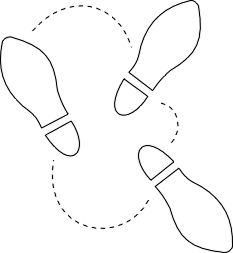
Learning to Dance, Learning to Pray

Have you ever wanted to take dance lessons?


I'm not talking about the electric slide. I mean the kind of dancing when you're at a wedding and an old standard comes on, and somebody's aunt and uncle go over to the dance floor, and they start doing a foxtrot. Or swing dancing. Both partners are moving together, they know the right moves to make, and it just looks...beautiful.

I've always liked dancing, but when a song requires a specific step, more often than not I choose to sit and watch. Not because I don't want to join in, but because I don't know the steps.

So how is praying like dancing?

When it comes to prayer, many of us are the same way. We're great at freeform or spontaneous prayer, but when it comes to liturgical prayer, we'd just as soon sit it out. Perhaps you've even wondered: why would anyone want to pray a prayer that's already been written down?

The answer is: for the same reason that couples learn the steps in order to be able to waltz, tango, or foxtrot. The same reason that playwrights write down lines and actors learn them. The same reason that jazz musicians learn standards.

Improvisation, freedom, and spontaneity...

...all three are key ingredients in all three of these activities (dancing, acting, and music). But without the form (steps, scripts, standards), all the spontaneity in the world can still end up feeling rote and tired.

Jewish prayer is rich with liturgy. To really understand it, you must try to think of the siddur (the Jewish prayerbook) as the steps to a dance. It's merely the outline, to show you where to place your feet. But you're the one dancing...you and God.

And there's more: by supplying you with words to pray, the siddur doesn't just give voice to things you want to say to God. It also teaches you new (old) ways to talk to God--not only individually, but as part of a people who have had an ongoing relationship with the God who first called them into peoplehood.

Prayer and the High Holy Days

The high holy day services have their own special prayers. All of these prayers have important meanings, and without understanding the meanings behind the prayers, we may find ourselves feeling unmoved...or bored. However, if we take the time to learn the meanings behind the traditions, we may discover a wealth of meaning...which will help our own relationship with God.

To learn more about Jewish prayer as "dancing through history," and how the siddur facilitates our "participation in a sacred drama," I recommend reading Rabbi Joshua Brumbach's two part series on rethinking Jewish prayer at the Yinon blog.

As you read Rabbi Joshua's articles, you can think about these questions:
  • What is prayer?
  • What are some of the obstacles that hinder us from praying? In what ways can the siddur help us to surmount these obstacles?
  • In what ways can liturgical prayers enable us to pray together with one voice as a community?
  • How does praying the traditional prayers of the Jewish people allow us to connect with Jewish history?

The Shofar 2, or 10 Reasons Why We Blow the Shofar

Why is this night different from all other nights? Why are we commanded to blow the shofar? Why do we eat kosher? Why, why, why?

If the Jewish tradition were like an annoying older brother, he would probably say "Sheket!"* to all your questions, and then go back to working on his blog whatever he was trying to say about how the spiral of the ram's horn resembles the intricacies of life's entanglements and blah blah blah blah bla...

Luckily for all of us, Jewish tradition isn't like a know-it-all older brother.

It's more like a zeyde...a twinkly-eyed Jewish family patriarch who loves to scoop you onto his lap and tell you stories about the time when Uncle Moshe led the entire family across the scalding hot sand, and how the manna tasted like borscht on Tuesdays and matzah brie every second Friday. Just like a zeyde, sometimes the tradition can tell stories that get kinda long, or go over your head, or even seem a bit gruff. But the older you get the more you realize that just as your bubbe or zeyde was an authentic link to the Jewish past, so the tradition is. And that without that link to the past, your Jewish present and future will be...well, let's just say more boring than a stage adaptation of Leviticus.

Jewish tradition is all about "Why?"

The midrash is all the "Why?"s asked by the great sages of Jewish history about the stories in the Torah. The Talmud is the "Why?s" asked by the sages about halakha (how we "walk out" the commandments in Torah). Why does the youngest child learn to sing "Ma Nishtana?" (the four questions) at the Passover seder? So she will be taught to ask "Why?"!

So why are you telling me this?

I'm glad you asked. On Rosh Hashanah we blow the shofar--great! But why? Why did God command us to blow the ram's horn on this day once a year?
The Saadia Gaon (9th century Jewish sage) suggested not just one, but 10 reasons. You could say that this is part of a long tradition of "top ten" lists that goes back to Moshe Rabbenu and the Ten Commandments. I was going to write out the list myself, but Derek Leman beat me to the punch.
So go ahead, check out Derek's article on the Saadia Gaon's ten reasons why we blow the shofar on Rosh Hashanah. Top that, Dave!

When you're finished, ask yourself:
  • Are the Saadia Gaon's reasons for blowing the shofar relevant to me today?
  • Which reason most resonates with me? What does that tell me about myself?
  • Which reason least resonates with me? Why? Does it point to an area in my beliefs where I could stand to learn more, or grow a bit?
  • How can I make sure to remember these reasons when we sound the shofar this Rosh Hashanah?

*Hebrew for "Quiet!"

Monday, August 31, 2009

The Shofar 1: "Awake, O You Sleepers"

What is the meaning of the shofar which we blow on Rosh Hashanah? A quotation garnered from S. Y. Agnon's Days of Awe:
Despite the fact that the blowing of the ram's-horn on Rosh ha-Shanah is an explicit decree in the Scripture, it is also an allusion, as if to say: Awake, O you sleepers, awake from your sleep! O you slumberers, awake from your slumber! Search your deeds and turn in Teshuvah. Remember your Creator, O you who forget the truth in the vanities of time and go astray all the year after vanity and folly that neither profit nor save. Look to your souls, and better your ways and actions. Let every one of you abandon his evil way and his wicked thought, which is not good. [Maimonides, Hilkhot Teshuvah III.4]
For more on the past, present, and future meanings of the shofar, from a Messianic Jewish perspective, check out Derek Leman's article Elul: Preparation, Reflection, Spiritual Discipline.

Repent one day before your death


Rabbi Eliezer would say: Repent one day before your death. (Pirkei Avot 2:10) He asked his disciples: Does a man know on which day he will die? Said he to them: So being the case, he should repent today, for perhaps tomorrow he will die; hence, all his days are passed in a state of repentance. Indeed, so said Solomon in his wisdom (Ecclesiastes 9:8): "At all times, your clothes should be white, and oil should not lack from your head' '' (Talmud, Shabbat
153a)
.
For more thoughts on teshuvah, repentance, from the prophet Haggai and from the teachings of Yeshua, check out David ben Avraham's article 'Tis the Season to Repent.

How do I go about doing teshuvah?

Elul is a season of teshuvah (repentance, turning). Last week we ended the week with the question, "And have you nothing to mend?" I want to start the week off with a different question: how do we do teshuvah?

The dangerous irony is that I could spend all month blogging about Elul and repentance and never actually get around to doing it. But how do I go about doing teshuvah?

Rabbi Shlomo Carlebach ("Reb Shlomo" to his followers) was known as "the singing rabbi." He was one of the most influential Jewish religious songwriters in the 20th century. He was also a pioneer in the baal teshuva movement, through which countless Jewish young people have returned to the Jewish faith and way. Reb Shlomo told two stories:
The first one is someone came to the Holy Rizhner* and said, “Can you please teach me how to repent?” and he answered, “Listen, man, when you did your sinning you didn’t come to me to ask me how to do it. If you know how to sin. You also know how to repent.”
The other story is, someone came to the Mittler Rebbe**, who’s like a master of Teshuva and has written many books on Teshuva. “You have written so many books; please teach me how to do Teshuva.” So the Mittler answers, “To tell the truth, after all the books I’ve written, I still don’t know.”
Reb Shlomo said "Even if you study all the books in the world about repentance, nobody can tell you how to do it, just you alone."

I think the truth Reb Shlomo was communicating is that teshuvah is something that comes from faith--it comes from the heart. Thus, there's no fool-proof formula that can be prescribed.

But just because there's no exact formula for teshuvah doesn't mean we should be discouraged. Rather, we should see it as an opportunity to serve God. Most of the practical advice I've read on doing teshuvah during the season of Elul has involved several things:
  • Set aside time to prayerfully consider your life before God. Go somewhere where you can be in solitude for a time.
  • Ask yourself questions like, "What regrets do I have from the previous year? What mistakes did I make? Is there anyone I need to ask forgiveness from? Are there any wounds in my heart that affect how I think of or relate to certain people--my spouse, my family, friends?"
  • Be specific--list out your realizations so that you can take them with you and continue to do the process of making things right. Then at the end of the high holy days you can dispose of the list as a way of showing that God forgives sin and accepts the penitent.
  • Don't go overboard in being introspective! Teshuvah isn't about beating yourself up. As much as possible, let your teshuvah be characterized by gratefulness (to God for revealing these things to you) and joy--the kind of joy you get when you return home after a time away.***
I'm committing to putting my money where my mouth is (as it were), by working through these practical steps in order to "bear fruits in keeping with repentance." (Matt 3:8) How about you?

For more practical advice on doing teshuvah, I recommend checking out Rabbi Russ Resnick's article "The Month of Elul."

* Yisroel Friedman (1797-1850) (Der Heyliger Rizhiner)
** Dov Ber of Lubavitch (1773-1827)
*** Returning home is how Reb Shlomo described the most fundamental way of teshuvah.

Friday, August 28, 2009

And have you nothing to mend?

Whew! My last few postings have been pretty chock full of information. That's all well and good, but I really don't want to lose sight of the spirit of Elul--the main point of doing these daily postings.

So, let's take inventory. I myself have definitely been swept into the preparatory spirit of Elul this week as God, in His mercy, has been bringing to light unresolved issues in my heart, and giving me the impetus to repent, to forgive, to make a change. How about you?

As we continue to allow God search our hearts this coming Shabbat, I thought I'd finish out the week with the following encouraging story:

Once on the New Moon of Elul, the zaddik* Rabbi Levi Isaac of Berditchev [18th cent] was standing at his window. A Gentile cobbler passed by and asked him, "And have you nothing to mend?"

At once the zaddik sat himself down on the ground and weeping bitterly cried, "Woe is me, and alas my soul, for the Day of Judgment is almost here, and I have still not mended myself!" (Days of Awe p. 26)
As you continue to prepare for the high holy days, make sure to take time to ask yourself before God: "Have I something to mend?"

* A zaddik (or tzaddik) is a righteous or saintly person. Within Hasidic Judaism particularly, the tzaddik is seen as a true spiritual leader and guide, a person to whom the Hasidim should cling in order to strengthen their relationship with Hashem.

Thursday, August 27, 2009

Why do we celebrate the new year at Rosh Hashanah?

Yesterday we ended with the question of where we got the name Rosh Hashanah [lit. "head of the year"] for the first day of the seventh month. Why do we observe the new year celebration in the middle of the year, on Rosh Hashanah?

The answer was alluded to in one of the footnotes from
yesterday's post:

There were two celebrations of a new annual cycle in ancient Israel, one in the spring month of Aviv (later called Nisan), 'the first of the months of the year' (Exod. 12:2), and another in the fall at 'the turn of the year' (Exod. 23:16, 34:22)." (Entering the High Holy Days, p. 4)
Did you catch that? In ancient Israel, there were actually multiple new years!

While this may at first seem strange, it actually is not. Here in the United States, we also have multiple new years: on January 1 we celebrate the turning of the year, while the government (and many corporations) have a fiscal year for accounting purposes. And schools start a new year each September!

Similarly,

In Judaism, Nissan 1 is the new year for the purpose of counting the reign of kings and months on the calendar, Elul 1 (in August) is the new year for the tithing of animals, Shevat 15 (in February) is the new year for trees (determining when first fruits can be eaten, etc.), and Tishri 1 (Rosh Hashanah) is the new year for years (when we increase the year number. Sabbatical and Jubilee years begin at this time). (http://www.jewfaq.org/holiday2.htm)
Thus, in the mishnah* we find:

The first of Tishre is the beginning of the year [Rosh Hashanah] for years, sabbatical cycles, and the jubilee. (M. Rosh Hashanah 1:1)
Similar to New Year's Day in the United States, Rosh Hashanah is the time in the Jewish calendar when the year number increases. But while in the U.S., the year increases on the first day of the first month, in the Jewish calendar, the year increases on the first day of the seventh month--at the "head" or "turn" of the year! Thus, it's become the custom to wish each other 'L'shana Tova!' (literally "To a good year!") at Rosh Hashanah, and to eat apples and honey in hope for a sweet year.

If this was new to you, let me know in the comments section below!

* The mishnah is the earliest written codification of Jewish oral traditions (compiled c. 200CE by Judah haNasi). It contains the details of how the people of Israel kept the commandments of the Torah in practice. The mishnah is the core around which the Talmud is organized.