Showing posts with label Talmud. Show all posts

Wednesday, December 5, 2012

Tablet journalist reading Daf Yomi discovers the origins of the Chanukah blessing

Tablet Magazine's Adam Kirsch is reading along with the Daf Yomi (the well-known Talmud reading cycle).  Currently he is studying through tractate Shabbat.  In Leading Lights: Week 10 of Our Literary Critic’s Daf Yomi Talmud Study, he comes across the Talmud's justification for employing the phrase "who commanded us" in the (clearly post-Biblical) observance of Hanukkah
[The rabbis note that the events of Chanukah] occurred in the 160s BCE, and the books that recount them are not part of the Hebrew Bible. This means that the holiday of Hanukkah is not a biblical but a rabbinic institution; and as we have seen before, rabbinic decrees are of lesser authority than biblical ones. 

This leads the Talmud to note an anomaly in the Hanukkah blessings. We praise God “who commanded us to light Hanukkah lights”: “But where,” the Gemara demands, “did He command us?” In fact, it was not God but the rabbis who commanded us to do this. Still, the Talmud attempts to reconcile this fact with the words of the blessing. Rav Arya cites a verse from Deuteronomy: “You shall not deviate from the word that they will tell you.” In context, “they” are the priests and judges of ancient Israel; but the rabbis see themselves as the priests’ inheritors, and they read the line as commanding obedience to all rabbinical decrees. 
This explanation is not commonly known in Messianic Jewish circles, where the rabbis are often accused of usurping divine or Biblical authority.  But such accusations rarely acknowledge the Deuteronomy passage referenced above, where authority to interpret the difficult questions raised by the Torah's teaching is actually delegated to the judges of Israel.

Is this authority then unlimited?  Interestingly, the Talmudic passage recognizes this very same question, continuing beyond the above logic to a more reserved conclusion.  Kirsch writes:

By this logic, however, everything the rabbis ordain should be considered just as sacred as what the Bible decrees—as the Gemara goes on to point out. The argument is finally settled by the common-sense opinion of Abaye: The blessing on Hanukkah is not absolutely required, but it is instituted “so that people do not treat [the holiday] with disrespect.” It follows that biblical holidays still take precedence over rabbinic ones: If a poor man has to choose between buying Shabbat candles and Hanukkah candles, the Talmud says he should pick the former.

Wednesday, November 28, 2012

"Lo bashamayim hi": G-dcast does the oven of Akhnai


Here's G-dcast's very creative rendition of the famous Talmudic "oven of Akhnai" story.


Usually people omit the second half of the story--which is arguably critical for understanding the whole point of the story.  Instead, they end the story with God laughing and saying "My children have defeated me!"  Good on G-dcast for telling the rest of the tale, which describes the strained relationship between R' Eliezer and Rabban Gamliel and how it led to their eventual death(s).

For the full text of this Talmudic tale, check out David Friedman's The Furnace of Akhnai: Story and Puzzle.  For one Messianic Jewish take on this tale, see Akhnai's Oven at Digging With Darren.

Monday, April 9, 2012

Yom HaBikkurim, urban legend

The title of this blog post is meant to catch your attention.  "Yom HaBikkurim, urban legend"!  Can it be true?

Well, not exactly.  Let me explain.

In Messianic Jewish circles, I regularly encounter references to the first day of the omer count as "Yom HaBikkurim."  I grew up with this being taught to me and continue to encounter it both on blogs and in books.  (Not to mention the omer count debate.  Seriously...don't mention it.  Not going there on this post.)  [Update: The reason for this teaching is to justify using the name Yom HaBikkurim as a "kosher substitute" for the term "Easter," the latter being something a non-sequitur of a name for those who didn't grow up within a tradition that uses it.  The underlying assumption is that Yom HaBikkurim is the Biblical holiday on which the resurrection of Yeshua took place.  For examples, simply Google "Yom HaBikkurim."]

However (unless one of you can persuade me otherwise), I'm strongly leaning towards the conclusion that "Yom HaBikkurim" refers not to the first day of the omer count at all--but rather, to the day AFTER the LAST day of the omer count.  In other words, Yom HaBikkurim is not a complete urban legend...it's another name for Shavuot.

Let's start by considering Numbers 28:26:
On the day of the firstfruits, when you offer a grain offering of new grain to the Lord at your Feast of Weeks, you shall have a holy convocation. You shall not do any ordinary work.
This verse equates "the day of firstfruits" (yom habikkurim) with "your Feast of Weeks."  A.k.a. Shavuot.

Case closed, right?

No--there's more!  Let's check out Leviticus 23--the chapter that holds all the answers, right?
And the Lord spoke to Moses, saying, "Speak to the people of Israel and say to them, When you come into the land that I give you and reap its harvest, you shall bring the sheaf of the firstfruits of your harvest to the priest, and he shall wave the sheaf before the Lord, so that you may be accepted. On the day after the Sabbath the priest shall wave it." (Lev 23:9-10)
Let's see: waving firstfruits, day after the Sabbath ...maybe (ignoring Num 28:26 for a second) this is Yom HaBikkurim?

I see two problems with this reading.  The first problem is that "firstfruits" are also mentioned later on in the chapter:
...count fifty days to the day after the seventh Sabbath. Then you shall present a grain offering of new grain to the Lord. You shall bring from your dwelling places two loaves of bread to be waved, made of two tenths of an ephah. They shall be of fine flour, and they shall be baked with leaven, as firstfruits to the Lord. (vv. 16-17)
and again in verse 20:

And the priest shall wave them with the bread of the firstfruits as a wave offering before the Lord, with the two lambs. They shall be holy to the Lord for the priest.
The second problem is that the word בִּכּוּרִים, bikkurim, does not appear in Lev: 23:9-10.  (Say what?)  That's right, the reference to "a sheaf of the firstfruits" in 23:10 is actually a translation of the phrase (עֹמֶר רֵאשִׁית, omer reisheet).  When the word bikkurim does appear in verses 17 and 20, it is referring to Shavuot.

I am aware of the section of mishna Zeraim called Bikkurim, but in my (limited) searching so far, I've seen no reference to the first day of the omer count as Yom HaBikkurim.  Strong's concordance 1061 also seems to concur with me here: "day of the first-fruits (Pentecost) Numbers 28:26."

In support of the first day of omer count as Yom HaBikkurim idea, I have only two observations (neither of which I find convincing):

First, many Bibles have a header above Leviticus 23:9-14 such as "The Feast of Firstfruits."  While that certainly predisposes readers of those Bibles to see that passage as describing such a festival (even leading some Biblical conspiracy theorists to speculate about why the feast of firstfruits "disappeared" from the Rabbinic calendar), it hardly constitutes an authoritative interpretation of the passage itself.

Second, there is the statement by the apostle Paul in 1 Cor. 15:20:
But in fact Messiah has been raised from the dead, the firstfruits of those who have fallen asleep. 
Paul is certainly using the language of harvest to describe Messiah's resurrection.  But I'm not convinced we can infer that the first day is "Yom HaBikkurim" in any official sense solely on this basis...only perhaps in a symbolic sense.

We might also ask whether Leviticus 23:9-14 is meant to be read as a distinct section from 15-22, but [see below] rather than going on, I think I'll simply close by restating my thesis as a question:

Is there any basis for referring to the first day of the omer count as Yom HaBikkurim?  Show me what I'm missing, friends!

Oh yeah, and happy Omer/Bikkurim to you all.

Update: I'm sure I'm not the first one to point this out.  So, wrong or right, if you want to point me towards articles addressing what I bring up here, I'd appreciate that too!

Second update: I had briefly suggested that perhaps Lev. 23:9-14 and 23:15-22 were not two distinct units, but verse 15 brought me back to reality: "From the day after the Sabbath, the day you brought the sheaf of the wave offering, count off seven full weeks."

Sunday, March 27, 2011

Why not eat lamb on Passover?

Passover is coming, the time for the eating of unleavened bread with bitter herbs and recounting the story of God's miraculous deliverance of the children of Israel from slavery in Egypt.

But what about that other command?  You know the one:
They shall eat the flesh [of the Passover lamb] that night, roasted on the fire; with unleavened bread and bitter herbs they shall eat it. Do not eat any of it raw or boiled in water, but roasted, its head with its legs and its inner parts. (Ex. 12:8-9)
So how about it--why don't [some] Jews today eat lamb on Passover?  [See the note below!]  Well, these verses only tell part of the story.  If you continue reading on, you'll discover that the Torah has more to say on the matter.

First, keep in mind that what makes the pesach a pesach (and not just a lamb) is that it is a korban (Num 9:7), a word which is strongly connected to offerings made on the altar in the mishkan (Tabernacle/Tent) in the wilderness.   (A good Biblical lexicon should confirm that the word pesach refers not just to the lamb, but to the sacrificed lamb.  In other words, pesach is an abbreviation for korban pesach.)

Thus, when the children of Israel celebrated the first Passover in the desert (see Numbers 9), they would have offered the korban pesach on the altar in the mishkan.  (In fact, Rashi inferred that the korban pesach was only offered the first year and wasn't offered again until the Israelites had entered the land of Israel.)

In the concluding book of the Torah, Deuteronomy, we find Moses instructing the children of Israel:
Take care that you do not offer your burnt offerings at any place that you see, but at the place that the LORD will choose in one of your tribes, there you shall offer your burnt offerings, and there you shall do all that I am commanding you. (Deut. 12:13-14)
Moses even specifically addresses the korban pesach in chapter 16:
You may not offer the Passover sacrifice within any of your towns that the LORD your God is giving you, but at the place that the LORD your God will choose, to make his name dwell in it, there you shall offer the Passover sacrifice, in the evening at sunset, at the time you came out of Egypt. (Deut. 16:5-6)
This is confirmed in 2 Chronicles 30, which describes how the korban pesach was offered in the Temple.

It seems that Yeshua and his followers also participated in this commandment:
And on the first day of Unleavened Bread, when they sacrificed the Passover lamb, his disciples said to him, "Where will you have us go and prepare for you to eat the Passover?" And he sent two of his disciples and said to them, "Go into the city, and a man carrying a jar of water will meet you. Follow him, and wherever he enters, say to the master of the house, 'The Teacher says, Where is my guest room, where I may eat the Passover with my disciples?' And he will show you a large upper room furnished and ready; there prepare for us." And the disciples set out and went to the city and found it just as he had told them, and they prepared the Passover. (Mark 14:12-16)
I'm specifically noting (a) that they were in the city to make their preparations and (b) that Mark specifically mentions the sacrifice of the Pesach lamb (although of course he's mentioning it for symbolic reasons as well).  (However, if their meal was not an official Passover seder (as John 18:28 seems to suggest), then of course they would not yet have eaten the korban pesach.)

Generally the offering of sacrifices in places other than the Temple is presented negatively in Tanakh--probably because of the connection to idolatry.  Examples include the "unauthorized" sanctuaries at Dan and Bethel (1 Kings 12), as well as the "high places" mentioned throughout the Deuteronomistic history.  You also get echoes of this in the prophets--mentioning Gilgal, Bethel, Dan, Beersheva--in Amos 4:4, 5:5, 8:14, Is. 4:15, Ezekiel 7:24--who refer negatively to "high places" and "sanctuaries."

The mandate to sacrifice the korban pesach in the Temple was retained by the rabbis of the Talmud, whose general reaction to the destruction of the Temple was to accept it as a (painful) judgment from God their father, who had thus made it impossible to offer korbanot.  They believed that the proper response to this judgment was to make teshuvah and pray for the Temple's restoration, rather than attempting to sidestep God's discipline by ignoring the clear requirement of a Temple (Deut 12:13-14, 16:5-6) for offering korbanot.

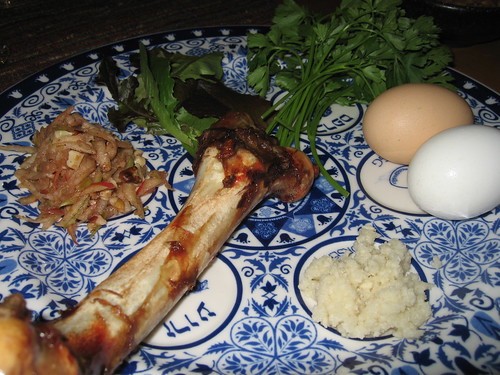
According to Wikipedia, "the ritual is no longer performed today [in Judaism] except by certain minority groups generally regarded as heretical."  The Ashkenazic tradition is to place a shank bone, known as a zeroa--on the seder plate--as a reminder of the korban pesach which we are unable to bring.

"Our Seder Plate" by Sam Felder, on Flickr
[Correction: The traditional elements of the "seder plate" are typically drawn from Ashkenazic practice and culture.  However, there is a diversity of Passover traditions--Sephardic, Moroccan, Yemenite--some of which may include the eating of lamb!]

Friday, March 25, 2011

Parasha Shemini: Fire on the Eighth Day

Cross-posted from The Set Table.


Our parasha draws its name from the opening phrase—Vay’hi ba’yom ha’shemini—”On the eighth day.” (9:1) After seven days of preparations for the mishkan led by Moses, the dedication of Aaron and his sons as priests is completed on the eighth day. On the significance of the number eight, the late Lubavitcher Rebbe comments:
The number “seven” signifies the normative order of the world…[days of the week, years in the Sabbatical cycle]…Seven, therefore, is the symbol for the order of nature. The number “eight” is beyond “seven,” alluding to the supra-natural, an emanation of G-dliness which, like a miracle, transcends the normative order.  (Living with Moshiach, p. 83)
In this case, the transcendent miracle which the people await is God’s visible acceptance of the offerings on the altar. The people know that the purpose of the mishkan is for God to dwell among the people. However, they also remember their sin with the golden calf. Thus, they are eager to see a manifestation of God’s presence which will assure them that atonement has been made.
In Leviticus 9:6 Moses foretells the appearance of the presence of the LORD as a response to their obedience. This becomes a sign of restoration and a cause for rejoicing for Israel:
…and the presence of the Lord appeared to all the people. Fire came forth from before the LORD and consumed the burnt offering and the fats on the altar. And all the people saw, and shouted, and fell on their faces.
(Leviticus 9:23b-24)
We noted that our parasha began with the word “Vay’hi“—which, the sages have observed, is a word indicating misfortune. This is revealed when Aaron’s sons Nadav and Avihu offer alien fire on the altar:
And fire came forth from the LORD and consumed them; thus they died before the LORD.
(Leviticus 10:2)
Praises turn to shock and grief. The entire community mourns, save Aaron and his surviving sons, who are forbidden to do so. Pesikta d’Rab Kahana provides an overview of numerous shortcomings of Nadav and Avihu proposed by rabbinic commentators: they ventured too near to God’s presence; they brought a superfluous offering; they offered strange fire; they stared at the Presence of God; they took no counsel with each other; they lacked the prescribed number of garments; they presumed to render a halakhic decision in the presence of Moses their master; they “treaded on the heels” of Moses and Aaron, saying “In no time these two old men will die, and in their place we shall assume authority over the community” (Piska 26.6-11).

Yet Moses statement of comfort to his brother Aaron suggests a further interpretation:
Then Moses said to Aaron, “This is what the LORD meant when He said, “Through those near to Me I show Myself holy, and gain glory before all the people.” And Aaron was silent.
(Leviticus 10:3)
Thus R. Hiyya bar Abba asks: “Since Aaron’s sins, [Nadav and Avihu], died on the first of Nisan, why does Scripture mention their death in connection with the Day of Atonement? [c.f. Lev. 16:1] To teach that as the Day of Atonement atones for Israel’s sins, so the death of the righteous atones for Israel’s sins” (Piska 26.11). Despite Nadav and Avihu’s shortcomings, their death becomes a means of glorifying God, and points to the atonement made through the death of the righteous.

All of this transpired “on the eighth day.” The Talmud connects the number eight to the days of the Messiah (see Arachin 13b). If the miracle of God’s presence on the eighth day of the mishkan brings with it a burning judgment, how much more will the future revelation of God’s glory throughout the whole earth at the days of the Messianic era also bring a judgment like fire from God’s presence? This is a judgment of sanctification, as it says: “I will be sanctified by those near to me.”

As we seek to prepare ourselves and the world for the entrance of the Messianic era, let us live lives of holy fear before the God who is a consuming fire.

If you don't already, subscribe to The Set Table at http://thesettable.org.  Shabbat shalom, readers!

Thursday, November 18, 2010

Quote of the Day: R' Isaac Lichtenstein on the Talmud

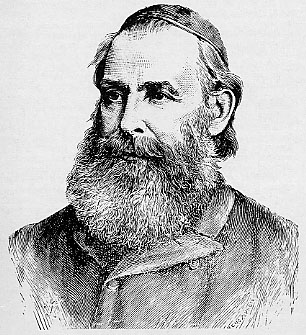
The latest issue of FFOZ's Messiah Journal contains a number of must-read articles, including biographies of Franz Delitzsch and Messianic luminary R' Isaac Lichtenstein.  The following quote is from "The Talmud on Trial," Lichtenstein's response to an anti-Talmud book published in his day called Netivot Olam ("The Old Paths").  Here's a brief excerpt from Lichtenstein's response:
Allow me to take this opportunity to demosntrate that the Talmud often agrees with the Gospels. Just as in all the main points of ethics there is agreement, so also both the Talmud and Gospels condemn pride, arrogance, and presumption. Consider the following concluding argument from the Talmud in regards to the above-cited quotation:
Whoever humbles himself, he will be lifted up by the Holy One, blessed be he; but whoever lifts himself up arrogantly in pride, he will be abased by the Holy One, blessed be he. Whoever covets positions of honor, from him honor retreats. Whoever shuns a position of honor, a position of honor pursues that one. Whoever tries to go against the“spirit of the times” (Zeitgeist), the current of time will oppose him; he will be pulverized by the flywheel of time. But whoever takes into account present-day conditions will find that time actually, regularly assists him and proves to be to his advantage. (b.Eruvin 13b)
This is the first time that Lichtenstein's "The Talmud on Trial" has been published in English.  Pick up a copy of the latest issue of Messiah Journal to read the whole thing!

Tuesday, June 22, 2010

J-BOM: a Torah of lovingkindness

Rabbi Elazar quoted this verse: "She opens her mouth with wisdom, and the Torah of lovingkindness is on her tongue" (Proverbs 31:26). What is the intent of this verse? Is there a Torah of lovingkindness and a Torah which is not of lovingkindness? Torah which is studied on its own merit is a Torah of lovingkindness, whereas Torah which is studied for an ulterior motive is not a Torah of lovingkindness. And some say that Torah which is studied in order to teach is a Torah of lovingkindness, whereas Torah which is not studied in order to teach is a Torah which is not of lovingkindness.
Sukkah 49b (Siddur Sim Shalom)
I used to think I had this one in the bag--after all, one of the things I love about learning is sharing with others! But I came across a passage in this month's J-BOM selection As A Driven Leaf which made me think again. A renowned philosopher asks Elisha ben Abuya:
Can we withdraw into books and their abstrusities when men need insight into their souls, balms for their wounds, and healing of their sorrows? . . . if you and I were the gods, as Epicurus describes them, we might devote our lives to debating the question whether or not Platonic ideas exist eternally in realms beyond space and time. But we are flesh and blood. We dare not, for an intellectual luxury, forget our aches or those of our brothers.
Steinberg's words (through the mouth of this Greek philosopher) point to my own shortcomings: am I content to retreat to a book when I should be transforming what little knowledge I have into something helpful to someone else? Messianic Jewish blogger Benjamin E. frames the question in the form of a challenge in the latest post on his new blog Living Torah (which I highly recommend!):
It seems like higher education is not going to take care of this one for us. Don't get me wrong. I'm all for the higher education. In fact, It is vital that we be an educated community. I just want to suggest that it would behoove us to be about our Father's business and at some point that means stepping outside of our classrooms/meetings/conferences into the world...And we're not handing out those tracts again!
How does a Torah of lovingkindness translate into real life? What does rising to Benjamin's challenge look like?

Sunday, June 20, 2010

A Father's Day Tribute

From Jewish Treats' "The Importance of Dad":
Two peas in a pod.  (Notice the matching fluorescent hats and clip-on sunglasses!)Where does a child learn to be a mentsch (a good person)? From his/her parents! Indeed, in the Talmud (Sukkot 56b) it even notes that a child repeats in the streets what he/she hears at home.

According to the sages of the Talmud, after circumcision and Pidyon Haben (redemption of the first born son), a father’s primary responsibilities are to teach the child Torah, to find him/her a spouse, and to teach the child a trade (Kiddushin 29a). At the bare minimum, his fatherly obligations mean making certain that the basic necessities of child-rearing are attended to (by a third party if necessary). But, the best child-rearing includes dad sharing his time, knowledge and wisdom, and truly leaving a lasting and meaningful impression on his children.
Growing up in a Messianic Jewish synagogue and attending a Messianic Jewish day school gave me a love of Torah--which my dad nurtured through regular conversations about life, God, and Torah (a practice we continue to this day). I remember many times hearing my dad exhort me to be a mensch.

My dad was also definitely involved in welcoming my wife Kristen into our family and encouraging me to pursue the wonderful eshes hayil I've been blessed to find.

Finally, my dad always encouraged me to surpass him in the trade I choose to practice. When I chose to get an engineering degree, he was behind me all the way.

As far as the Talmud is concerned, my dad fulfilled his responsibilities to me...in spades! And with the sages I heartily agree. Thanks, Dad.

Friday, June 4, 2010

Guest post: Shabbat as "bride" and "queen"

A few weeks back, I posted some thoughts from Judith Shulevitz on "light Sabbath" vs. "dark Sabbath." Messianic blogger Paula from Grasping Mashiach made a great comment illustrating how Shulevitz's "light/dark Sabbath" is really a recapitulation of the teachings of the sages about Shabbat as bride/queen, which is itself based on the Torah's command to remember/observe (zachor/sh'mor):
The idea of Sabbath as light and dark reminds me of the rabbinic concepts of Shabbat as bride (Shabbat HaKallah) and queen (Shabbat HaMalchah), framed in more palatable and modern language. Samuel Dresner in his book “The Sabbath” explains bride as feelings of love and desire toward the Sabbath and queen as laws of observance regarding the Sabbath.

Chazal (Shevu’oth 20b) relate that remembering Shabbat and keeping Shabbat were given by HaShem in a single utterance (based on Exodus 20:8 in relation to Deuteronomy 5:12). Remembering is the bride, the light part of Sabbath, the longing for the experience of freedom, peace, and rest. Keeping is the queen, or the dark part of Sabbath, the laws and statues. But both remembering and keeping, bride and queen, light and dark are part of the same entity. As Dresner puts it;

"One can never truly know the inward feeling (bride) of Sabbath without the outward form (queen)."

Like a queen the Sabbath is a reigning monarch who arrives on the seventh day despite the will or liking of man. When a queen is in the palace everything must be in order and certain protocol followed, yet it is the protocol or “rules” that enable the experience of inner peace.

With this in mind I wonder if just a “little” darkness is the answer regarding Shabbat? Certainly, people have to start somewhere in observance, but inevitably it would seem that “remembering” and “keeping” or emotional desire and specific observance/discipline must have equal balance and weight in order to celebrate Shabbat to its full and intended extent.

Monday, April 5, 2010

Are you standing on one leg?

From Visions of the Fathers, on the three pillars which support the world from Pirkei Avot 1:2:
R' Yechezkel Landau of Prague (Noda BeYehudah) urged his congregants to greater exertion in giving tzedakah and doing acts of chesed. When he found that his biddings were not being heeded, he closed the local yeshivah and conspicuously wandered the streets as if he had nothing to do. When he was asked about this unusual behavior, R' Landau said, "The Talmud tells us that there are three pillars that support the world: study of Torah, the Divine service, and acts of chesed. If a table which stands on three legs loses one of its legs, it can continue to be used if something is placed under it for support. However, if there are no longer acts of chesed, the only thing to do is to remove the third leg. When the community became lax in acts of chesed, my only option was to close the yeshivah, thereby removing the third leg of Torah. If the community will resume doing chesed, I will open the yeshivah again.
Are you or your community standing on one leg?

Wednesday, January 20, 2010

Rabbi Steinsaltz on MLK, cont.

On Monday night I heard Rabbi Adin Steinsaltz speak on the legacy of Rev. Dr. Martin Luther King, Jr. I'm sharing my notes from the talk so that you readers can benefit from it, as well as to give us an opportunity to discuss what he said!

After a few light-hearted opening statements (on the sponsor's succinct introduction: "Thank you for making that an introduction and not an obituary."), Rabbi Steinsaltz began his talk by admitting, "This is the first time I have to do a commentary on the writings of a priest" (meaning Dr. King). "Hopefully I can deal with it," he added jokingly.

He then started with an observation: Dr. King's speeches were filled with quotations of Scripture, but all of them* come from the Tanakh. ("The Old Testament," he clarified, since "I'm in America.")

R. Steinsaltz suggested that perhaps this wasn't a terribly PC thing for him to say (On politically correctness: "the one law in Washington that nobody breaks"). And to be clear: "I'm not saying that MLK was a 'crypto-Jew.'" Rather, R. Steinsaltz wanted to make the point that in his fight for justice, the bulk of Dr. King's scriptural inspiration came from the Old Testament. This is because, R. Steinsaltz continued, there is a difference between the moral message of the Old Testament and the New Testament.

I'll continue with this later in the week, but for now: what do you think? Is R. Steinsaltz right about MLK? What difference in moral message between Old Testament and New Testament do you think R. Steinsaltz is getting at?

* Or most--R. Steinsaltz admitted that there may be a few he was leaving out.

Monday, December 21, 2009

What is the Talmud? (Do you know?)


If someone had turned to me after class one day in high school or college and asked me, "What is the Talmud?" I probably wouldn't have been able to give more than a vague answer--something along the lines of "traditional Jewish commentaries on the Bible."

Now technically that answer's not wrong, but if you came from a Christian (or even Messianic) upbringing, you might expect that, as a Bible commentary, the Talmud would have the following basic characteristics:
  • Exposition and background information on the books of the Bible
  • Commentary, ordered according to books/passages of the Bible
  • Verse references backing up statements that are made
  • (What other characteristics do you readers think someone might expect?)
If you've read any of the Talmud (60+ tractates!), you know that these don't adequately describe it. Rabbi Joshua from Yinon gives us a better definition of the Talmud in a recent post:
The Talmud is really just volumes of case law, setting prior precedents for understanding, interpreting, and establishing halachah. Attorneys, and those familiar with legal codes really get this. One of the major aspects that separates Judaism from other religions like Protestant Christianity is this notion of halachah (of Jewish law). Jewish life and practice is established on prior communal precedent. One cannot just do what one sees fit. There are accepted previous understandings and interpretations that determine Jewish life and observance. And proper innovation and creativity should be established based on communal understanding of these prior precedents. [Emphases mine]

Thus, anyone who opens the Talmud expecting something like the Jewish version of Matthew Henry's commentary on the Bible or Calvin's Institutes is in for a surprise. (In fact, they might be tempted to chuck the whole thing and conclude that, since the Talmud is full of "traditions of men," it would be useless--or even dangerous!--to allow it to influence the way we think about Scripture. Hopefully that person would think twice, and choose to learn more about what the Talmud is before rushing to judgment.)

Rabbi Joshua's post has reminded me that I have several introductory books on the Talmud on my shelf which I've been meaning to read. If you want to join me, the books are Adin Steinsaltz's The Essential Talmud and Abraham Cohen's Everyman's Talmud. (If you have others to recommend, do chime in!)

Even if you don't have time to read a whole book, you at least owe it to yourself to read a little bit (or a bissel, as they say in Yiddish). I recommend checking out Derek Leman's articles over at Messianic Jewish Musings:
I'll close with a teaser from Derek's Talmud, Messianic Judaism, and Imperfect Truth (in fact, I may have subconsciously stolen the idea for this post from him!):
Talmud is not what you think it is.
I say that because Talmud is not what I thought it was. I had done a fair amount of reading in Talmud and about Talmud before taking a class, which I am half-way through, at the Messianic Jewish Theological Institute (mjti.org).
Wow, was I ever wrong. So I will just assume that you are wrong as well about what is in Talmud and what it’s purpose is.
I don’t intend to go in depth here and give you examples. I intend only to open your mind to something and perhaps create a desire for further study (guided study, by a qualified instructor — it is foolish to think you can learn Talmud on your own or by reading a few books).
Duly noted, Rabbi Derek. However, for now, "a few books" will have to do!

Saturday, December 19, 2009

A Post-Hanukkah Post

Rabbi Gil Steinlauf (from DC synagogue Adas Israel) asks (with the rabbis of the Talmud), "Mai Chanukah?"--what is Hanukkah? He writes:
I once heard a wonderful story about a man whose Native American friend came to visit him in New York City. The Native American had never before been to New York, or to any big city. All day he gave his friend a marvelous tour, the East Side, the West Side, uptown, downtown. When night fell, he took him to see—what else?—Times Square, with its dazzling spectacle of lights and sounds. And as they stood there, gazing at it all, the Native American suddenly started looking up with a troubled, bewildered expression, his gaze darting here and there erratically. The man became concerned about his friend: “Are you alright?” he asked. “I just heard the call of a yellow-bellied warbler bird somewhere around here, and I’m trying to find him,” said the Native American. The man laughed, “My friend, there are many noises here, and maybe lots of pigeons, but I doubt that what you heard was a yellow-bellied…” He didn’t finish his sentence when his friend excitedly pointed “There he is!” And indeed, there on a ledge was the yellow bellied warbler! The New Yorker was flabbergasted! “How could you possibly do that!?” he asked. The Native American showed him. He reached into his pocket and scattered all his change on the sidewalk. Immediately, 150 heads turned and looked for where the sound of the change was coming from. “All these people come to the city in search of riches and bargains, so their ears are trained to listen for money. On my reservation, I spend my whole life listening for the sounds of the animals and the birds. It doesn’t matter where I go. I am always listening for their voices.”
What's Rabbi Steinlauf's point? The essence of Hanukkah is this: seek out the light. That certainly resonates with me, and I hope it does with you too.

Read the whole post over at Rabbi Steinlauf's blog, Dover Emet.

Monday, November 30, 2009

Being "Godly" 2

Continuing our thread on being "Godly":
"Follow the Lord your God" (Deuteronomy 13:5). What does this mean? Is it possible for a mortal to follow God's Presence? The verse means to teach us that we should follow the attributes of the Holy One, praised be He. As He clothes the naked, you should clothe the naked. The Bible teaches that the Holy One visited the sick; you should visit the sick. The Holy One comforted those who mourned; you should comfort those who mourn. The Holy One buried the dead; you should bury the dead.

Rabbi Simlai taught: The Torah begins with deeds of lovingkindness and ends with deeds of lovingkindness. It begins with deeds of lovingkindness, as it is written, "And the Lord God made for Adam and for his wife garments of skins and clothed them" (Genesis 3:21). It ends with deeds of lovingkindness, as it is written, "And He buried him in the valley in the land of Moab" (Deuteronomy 34:6).
~Talmud, Sotah 14a
Siddur Sim Shalom, p. 19

Friday, November 20, 2009

The Second Soul of Shabbat

When G-d drove Adam from Paradise, he retained part of his soul to remain there. On Shabbos, G-d releases that part and gives it back to man. This is our extra soul of Shabbos. On this day we are given the opportunity to return to Paradise.

Now, I must be satisfied with Paradise on Shabbos; in the future we hope to be brought to Jerusalem of High.
There is a tradition within Judaism that on Shabbat we all receive an extra soul with which to enjoy the Sabbath. As I said in a previous post, in the past I had found this idea intriguing and even beautiful, but I didn't see any way to integrate it into the rest of my beliefs. However, recently an idea occurred to me which I want to share with you.

The Talmud says that Shabbat is "a taste of the world to come." (Berachot 57b) The author of the letter to the Hebrews made a similar point when he or she wrote "So then, there remains a Sabbath rest for the people of God." (Hebrews 4:9a) The point is the same: the Sabbath is a sign pointing not just to the past, but also to the future.

So what about this second soul? Well, if in order to experience the joy of Shabbat, God gives us each week a neshama yiterah, a second soul, how much more does this imply that we should receive a neshama yiterah gedolah in order to experience the joys of the world to come, where we will enjoy an even greater rest and know an even greater delight?

In fact, since the sages say in that same passage of Talmud that "Shabbat is one sixtieth of the world to come," then that implies that the neshama yiterah we receive on Shabbat must be one sixtieth of the neshama yiterah we receive from God in order to enter into the World to Come!

I believe this is in fact a teaching of Yeshua, when he said in a discourse to one of the teachers of Israel:
Truly, truly, I say to you, unless one is born from above, he cannot see the kingdom of God. (John 3:3)
Yeshua taught that in order to see the kingdom of God, a person had to receive from God a second soul. This is no less than the fulfillment of the promise God made to Israel through the prophet Ezekiel
I will give you a new heart and put a new spirit in you. (Ezekiel 36:26a)
So, when we sanctify the Shabbat, let's thank God for the little neshama yiterah with which we can enjoy the beauty of the day. And let it also remind us each week to thank God for the greater neshama yiterah by which we will one day enter into the great Shabbat which is the World to Come.

Shabbat shalom, friends.

Monday, August 31, 2009

Repent one day before your death


Rabbi Eliezer would say: Repent one day before your death. (Pirkei Avot 2:10) He asked his disciples: Does a man know on which day he will die? Said he to them: So being the case, he should repent today, for perhaps tomorrow he will die; hence, all his days are passed in a state of repentance. Indeed, so said Solomon in his wisdom (Ecclesiastes 9:8): "At all times, your clothes should be white, and oil should not lack from your head' '' (Talmud, Shabbat
153a)
.
For more thoughts on teshuvah, repentance, from the prophet Haggai and from the teachings of Yeshua, check out David ben Avraham's article 'Tis the Season to Repent.