
Showing posts with label prayer. Show all posts
Showing posts with label prayer. Show all posts
Monday, April 30, 2012
Learning from Levertoff: "Prayer and Love" (Part 2)
Here is Part 2 of me discussing "Prayer and Love" from Love and the Messianic Age by Paul Phillip Levertoff.

Tuesday, April 24, 2012
Learning from Levertoff - "Prayer and Love"
Here is Yahnatan discussing "Prayer and Love" from Paul Philip Levertoff's Love and the Messianic Age.
Tuesday, September 22, 2009
A Simple New Years Resolution
One of my favorite blogs is A Simple Jew. Here's a great example of why:
אתה. I have resolved that this one word, comprised of just three letters, is going to be the focus ofmy avodas Hashem for 5770. I have rushed over the word אתה so many times... Beginning with the new year, I have made it a practice to slow down anytime I encounter this word... It is my sincere hope that by doing this that my kavana [intent] and deveykus [devotion] will increase significantly over the course of the next year; allowing me to come even just a small step closer to shleimus hatefilla (perfected prayer).
What simple resolutions can you make during these days to help you come closer to God?
(A word of advice: if you make a resolution to do something better this year, tell a friend! I've done this several times over the past few years, and it's made all the difference. Special thanks to those friends--you know who you are!)
(A word of advice: if you make a resolution to do something better this year, tell a friend! I've done this several times over the past few years, and it's made all the difference. Special thanks to those friends--you know who you are!)
Thursday, September 3, 2009
Learning to Dance, Learning to Pray
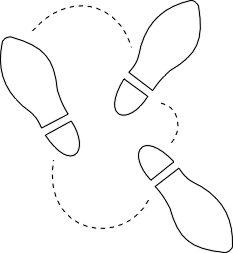 Have you ever wanted to take dance lessons?
I'm not talking about the electric slide. I mean the kind of dancing when you're at a wedding and an old standard comes on, and somebody's aunt and uncle go over to the dance floor, and they start doing a foxtrot. Or swing dancing. Both partners are moving together, they know the right moves to make, and it just looks...beautiful.
I've always liked dancing, but when a song requires a specific step, more often than not I choose to sit and watch. Not because I don't want to join in, but because I don't know the steps.
So how is praying like dancing?
When it comes to prayer, many of us are the same way. We're great at freeform or spontaneous prayer, but when it comes to liturgical prayer, we'd just as soon sit it out. Perhaps you've even wondered: why would anyone want to pray a prayer that's already been written down?
The answer is: for the same reason that couples learn the steps in order to be able to waltz, tango, or foxtrot. The same reason that playwrights write down lines and actors learn them. The same reason that jazz musicians learn standards.
Improvisation, freedom, and spontaneity...
...all three are key ingredients in all three of these activities (dancing, acting, and music). But without the form (steps, scripts, standards), all the spontaneity in the world can still end up feeling rote and tired.
 Jewish prayer is rich with liturgy. To really understand it, you must try to think of the siddur (the Jewish prayerbook) as the steps to a dance. It's merely the outline, to show you where to place your feet. But you're the one dancing...you and God.
And there's more: by supplying you with words to pray, the siddur doesn't just give voice to things you want to say to God. It also teaches you new (old) ways to talk to God--not only individually, but as part of a people who have had an ongoing relationship with the God who first called them into peoplehood.
Prayer and the High Holy Days
The high holy day services have their own special prayers. All of these prayers have important meanings, and without understanding the meanings behind the prayers, we may find ourselves feeling unmoved...or bored. However, if we take the time to learn the meanings behind the traditions, we may discover a wealth of meaning...which will help our own relationship with God.
To learn more about Jewish prayer as "dancing through history," and how the siddur facilitates our "participation in a sacred drama," I recommend reading Rabbi Joshua Brumbach's two part series on rethinking Jewish prayer at the Yinon blog.
As you read Rabbi Joshua's articles, you can think about these questions:
- What is prayer?
- What are some of the obstacles that hinder us from praying? In what ways can the siddur help us to surmount these obstacles?
- In what ways can liturgical prayers enable us to pray together with one voice as a community?
- How does praying the traditional prayers of the Jewish people allow us to connect with Jewish history?
Subscribe to:
Posts (Atom)

